What is Poly B? The pipe in hundreds of thousands of Canadian homes
For twenty years it was the smart, modern choice for plumbing a new Canadian home. Then production stopped, the code dropped it, and insurers started asking about it by name. Here is the whole story in one place.
The 30-second answer
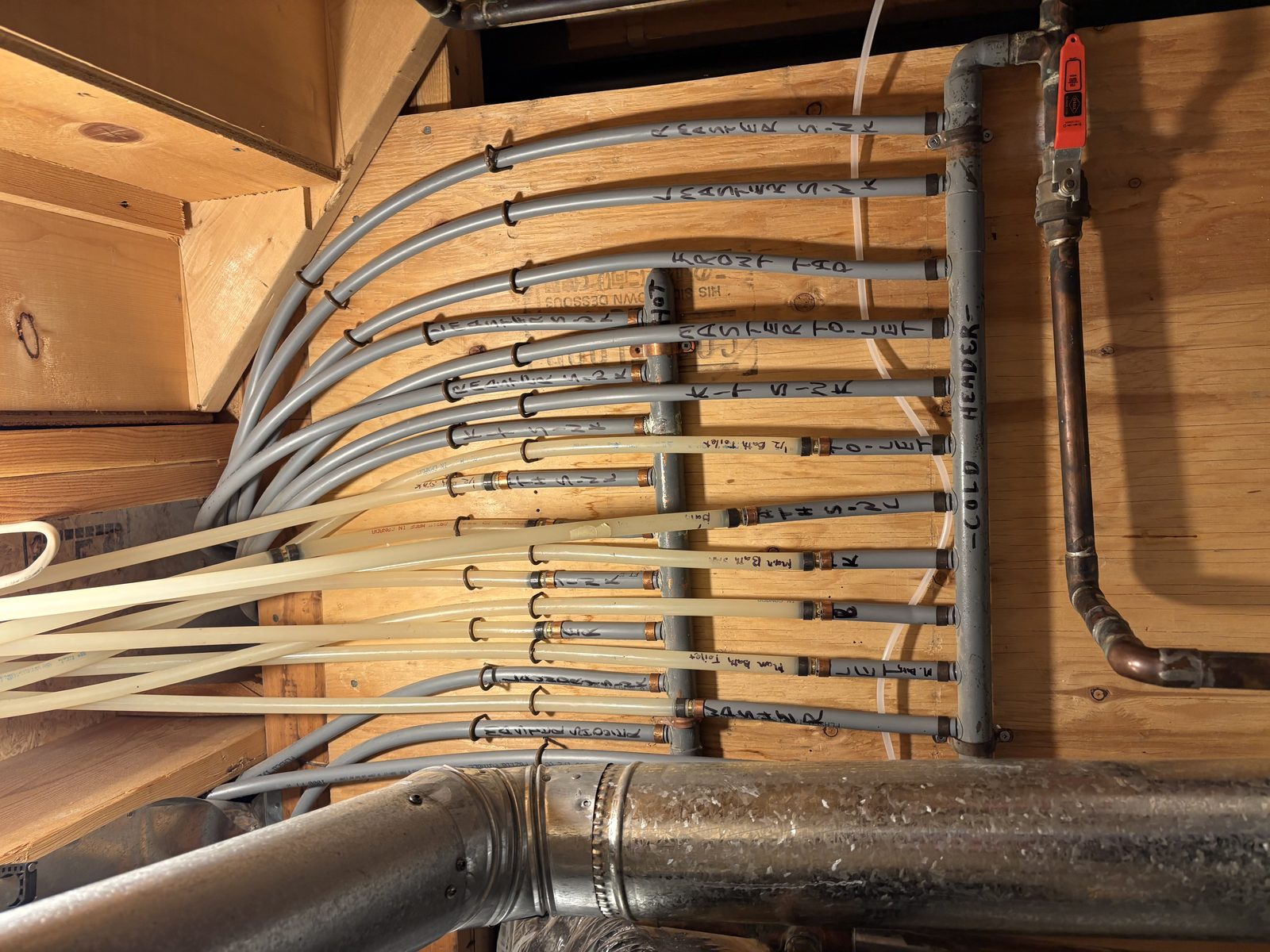
Poly B is polybutylene, a flexible plastic water supply pipe, usually grey and stamped PB2110, installed in Canadian homes roughly 1978 to 1998. Industry reporting puts it in the range of 700,000 Canadian homes. It carries your drinking water; it is not a drain pipe.1
Why builders loved it
Compared to copper, Poly B was inexpensive, fast to install, and flexible enough to snake through framing with far fewer joints. It didn't need soldering, tolerated freezing better than rigid pipe, and was certified to a recognized Canadian standard, CSA-B137.8, and accepted by the National Plumbing Code of the day.2 Through the building booms of the 1980s and 1990s, entire subdivisions went in with it. Builders weren't cutting corners; they were using an approved, modern material.
The timeline
- '78Poly B begins appearing in Canadian homes, with installations running from roughly 1978 through the late 1990s.1
- '90sFailures mount in the US, centred on plastic acetal fittings and chlorinated water, leading to the massive American class action. Canadian failure rates run lower, especially in Alberta where metal fittings were the norm.3
- '98Manufacturers stop producing the polybutylene resin in spring 1998. New installations end as supply runs out.2
- '05The National Plumbing Code of Canada removes Poly B as an accepted material. The change is not retroactive: existing installations remain legal.4
- NowEvery Canadian Poly B system is 28 to 48 years old, at or past its expected service life, and insurers increasingly ask about it by name.
How much is out there
Industry reporting commonly cites around 700,000 Canadian homes built with Poly B, and Alberta's regulator has cited an unconfirmed estimate of roughly 148,000 homes in that province alone.2 The concentration follows the construction booms: if a neighbourhood went up between the late 1970s and late 1990s, Poly B is a live question there. Our address checker on the home page maps exactly that, neighbourhood by neighbourhood in Calgary, Edmonton, and Kelowna, and by census build-era data everywhere else in Canada.
What Poly B is not
Three lookalikes cause endless confusion. PEX is the modern flexible pipe used in replacements today; it's a different plastic that doesn't share Poly B's chlorine problem, and some PEX is even grey. Kitec is a different product entirely, a plastic-aluminum composite pipe from a later era with its own separate class action; the two are often conflated and shouldn't be. And drain pipes, the large black or white ABS and PVC lines, have nothing to do with Poly B, which was only ever a supply pipe.5 The stamp settles it: the identification guide shows exactly what to look for.
Where the story goes from here
If your home has Poly B, three chapters carry the practical answers: how to confirm it, what it means for your insurance, and what replacement actually costs. And if you've heard that the Supreme Court banned it or that a big settlement will pay for your repipe, the myths chapter has the real record.
Sources for this page
- Canadian plumbing industry reporting on Poly B prevalence and installation era
- Alberta Municipal Affairs, Polybutylene (Poly-B) fact sheet
- US class action records (Cox v. Shell Oil Co.) and Canadian failure-rate analyses
- National Plumbing Code of Canada, 2005 revisions (NRC-CNRC)
- Canadian legal and industry documentation distinguishing Poly B, PEX, and Kitec
Facts on this page are drawn from the government, legal, and industry documents named above and rewritten for clarity. This library keeps everything you need in one place.

Published by Poly B Plumbing Guys
This library is maintained by the team that replaces Poly B every day across Alberta and BC. Red Seal certified plumbers, full remove-replace-restore service including drywall and paint, a 25-year warranty, and the completion certificate insurers ask for.
Get your pipes checked →